All those free internet services we enjoy? This is how they get paid for. Remember, if you’re not paying for the product, you are the product.

Found via Cool Infographics
All those free internet services we enjoy? This is how they get paid for. Remember, if you’re not paying for the product, you are the product.
Found via Cool Infographics
Cool chart from Quartz that helps visualize unemployment rates and what’s included / not included in the official unemployment rate and the broader, U6 measure:


Source: Information is Beautiful
The Absolute Return Letter: The Need for Wholesale Change
A good read about the state of the markets. Below you’ll find a hodgepodge of excerpts I found interesting – read the letter in its entirety for a more coherent argument. Note: everything you read below is a directly quoted excerpt.
Intro & Chart:
On 5 March 2013 the Dow Jones Industrial Average set a new all-time high, surpassing
the previous high of 14,165.50, established back in October 2007. Only the stock
market doesn’t seem to recognise that the world is a very different place today when
compared to 5 ½ years ago. Many investors talk the bearish talk, yet they walk the
bullish walk. This apparent inconsistency is a function of the widespread belief that
central bank policy, whether emanating from Tokyo, Frankfurt, London or
Washington, provides an effective volatility hedge, allowing investors to ignore the
underlying economic and financial problems that continue to simmer. Chart 1 landed
in my inbox a few weeks ago, courtesy of Simon Hunt. A chart often says more than a
thousand words; it certainly does in this case.
Chart 1: Now and Then – 2013 vs. 2007
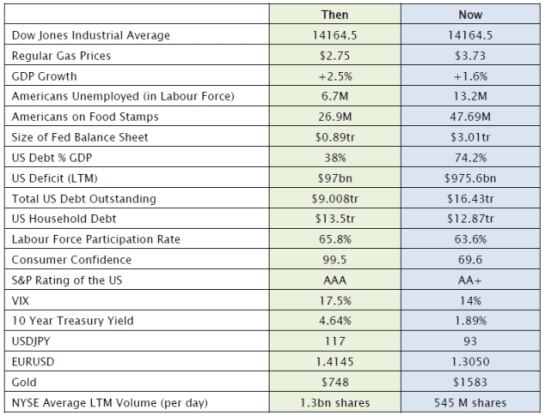
Source: Charles de Trenck, Transport Trackers. U.S. data unless otherwise indicated.
The Comedy Called Cyprus
I have long argued that the creation of the European Monetary Union was akin to
reintroducing the gold standard. The eurozone member countries are effectively
locked into a system very similar to the one that proved so hopelessly inadequate
during the great depression in the early 1930s. A monetary union is quite simply the
wrong model for a rapidly ageing Europe, but a combination of ignorance and
stubbornness means that those in charge refuse to see the writing on the wall.
The last couple of weeks have provided ample evidence that the political leadership in Europe is utterly clueless as to how to resolve the crisis. If there were any trust left between the public and our elected leaders that has now been unequivocally broken with the disastrous handling of the crisis in Cyprus.
It is a well known fact that European banks depend more on deposits for their funding requirements whereas U.S. banks tend to primarily use capital markets. The fact that European policymakers were prepared to sacrifice small depositors in Cyprus demonstrates a shocking lack of knowledge of this reality. How do they think depositors in other eurozone countries will interpret this blatant attack on private savings? At a time where banks need access to funding more than ever? An invisible line in the sand has been crossed and there is no way back. Next time a bank in a major eurozone country runs into serious difficulties, there is likely to be a bank run, primarily because the trust was broken with the shambolic handling of events in Cyprus. As outgoing BoE Governor Mervyn King once quipped (and Iparaphrase): “It is irrational to start a bank run but, once it gets going, it is perfectly rational to join in.”
Triffin’s Dilema
The chronic U.S. current account deficits of the 1950s and 1960s created a build-up of substantial U.S. dollar reserves in Europe and Asia just like now. Unlike now, however, the creditor nations would redeem those dollars for gold, depleting U.S. gold reserves to the point where they became
dangerously low. Today’s creditor nations redeem their dollars for U.S. Treasuries
instead.
With the U.S. off the gold standard, the ability for the government to honour its
obligations in gold is no longer an issue. It is instead the future purchasing power of
U.S. Treasuries that is at stake; hence the system is still intrinsically unstable.
An Emerging Dollar Bull Market?
Central bankers around the world are obviously aware of all these issues and this is where the story gets interesting. In central bank circles there is a growing realisation that monetary policy as prescribed over the past few years has become largely ineffective. The Bank of England buying another batch of gilts or the Fed acquiring yet more Treasuries has simply lost its va-va-voom.
Central bankers are therefore beginning to realise that they are running out of options in terms of propping up the global economy and something altogether different shall be required. It is in that light that the rumour mill is working overtime. Would it be far-fetched to expect a globally coordinated initiative whereby central banks step in with a groundbreaking new plan as to how the global economy and monetary system should be run?
For that to occur, our political leaders would have to be forced into a corner. That could only happen if the financial system became overwhelmed by yet another crisis. Policy makers simply won’t make the difficult decisions unless there is no other choice. Following that logic, central bankers actually have an interest in, and could do the world a favour by, ‘creating’ another financial crisis. Religiously targeting ZIRP is a good starting point. Near zero percent interest rates encourage risk taking to the extreme as we have seen over the past few years. Extreme risk taking leads to asset bubbles which will ultimately feed a crisis somewhere.
You may think that I have lost my marbles. I am not so sure. None of this is taken out of thin air. I have friends and acquaintances in many strange places around the world and this has come through one of the more trusted channels. Will it happen? I honestly don’t know but it is probably the best shot we’ll have at profoundly changing the monetary infrastructure of the world and for precisely that reason I hope it does happen.
A slightly better chart than the one I posted in my Mt. Bernanke post:

“Bull markets are born on pessimism, grown on skepticism, mature on optimism and die on euphoria.” -Sir John Templeton
The article this chart is from is worth a read: Stages in a Bubble – below is the introductory paragraph.
Business cycles are a well understood concept commonly linked with technological innovations, which are often triggering a phase of investment and new opportunities in terms of market and employment. The outcome is economic expansion and as the technology matures and markets become saturated, expansion slows down. A phase of recession is then a likely possibility as a correction is required to clear the excess investment or capacity that irremediably occur in the later stages of an economic cycle. The bottom line is that recessions are a normal condition to a market economy as they are regulating any excess, bankrupting the weakest players or those with the highest leverage. However, one of the mandates of central banking is to fight a process (business cycles) that occurs “naturally”. The interference of central banks such as the Federal Reserve appear to be exaggerating the amplitude of bubbles and the manias that fuel them. It could be argued that business cycles are being replaced by phases of booms and busts, which are still displaying a cyclic behavior, but subject to much more volatility. Although manias and bubbles have taken place many times before in history under very specific circumstances (Tulip Mania, South Sea Company, Mississippi Company, etc.), central banks appear to make matters worst by providing too much credit and being unable or unwilling to stop the process with things are getting out of control (massive borrowing). Instead of economic stability regulated by market forces, monetary intervention creates long term instability for the sake of short term stability.
There is a great article about Warren Buffett’s approach to investing from The American Association of Independent Investors (link). The article is from January 1998 but the advice is timeless. Below is a summary of his approach. The article itself is a quick and easy read, well worth your time.
The Warren Buffett Approach
Philosophy and style
Investment in stocks based on their intrinsic value, where value is measured by the ability to generate earnings and dividends over the years. Buffett targets successful businesses—those with expanding intrinsic values, which he seeks to buy at a price that makes economic sense, defined as earning an annual rate of return of at least 15% for at least five or 10 years.
Universe of stocks
No limitation on stock size, but analysis requires that the company have been in existence for a considerable period of time.
Criteria for initial consideration
Consumer monopolies, selling products in which there is no effective competitor, either due to a patent or brand name or similar intangible that makes the product unique. In addition, he prefers companies that are in businesses that are relatively easy to understand and analyze, and that have
the ability to adjust their prices for inflation.
Other factors
• A strong upward trend in earnings
• Conservative financing
• A consistently high return on shareholder’s equity
• A high level of retained earnings
• Low level of spending needed to maintain current operations
• Profitable use of retained earnings
Valuing a Stock
Buffett uses several approaches, including:
Stock monitoring and when to sell
Does not favor diversification; prefers investment in a small number of companies that an investor can know and understand extensively. Favors holding for the long term as long as the company remains “excellent”—it is consistently growing and has quality management that operates for the benefit of shareholders. Sell if those circumstances change, or if an alternative investment offers a better return.
On Sunday the NYT ran an interesting op-ed by former Congressmen and Reagan’s budget director, David Stockman. The article has an extremely pessimistic outlook for our country and economy; you might even think you were reading Zero Hedge and not the NYT (the only difference is Stockman recommends holding cash as opposed to gold).
He highlights some huge problems facing our nation – the most discouraging is our government’s inability to do anything about them. Below are a few paragraphs that sum things up. The whole article is worth your time and attention (link).
The future is bleak. The greatest construction boom in recorded history — China’s money dump on infrastructure over the last 15 years — is slowing. Brazil, India, Russia, Turkey, South Africa and all the other growing middle-income nations cannot make up for the shortfall in demand. The American machinery of monetary and fiscal stimulus has reached its limits. Japan is sinking into old-age bankruptcy and Europe into welfare-state senescence. The new rulers enthroned in Beijing last year know that after two decades of wild lending, speculation and building, even they will face a day of reckoning, too.
THE state-wreck ahead is a far cry from the “Great Moderation” proclaimed in 2004 by Mr. Bernanke, who predicted that prosperity would be everlasting because the Fed had tamed the business cycle and, as late as March 2007, testified that the impact of the subprime meltdown “seems likely to be contained.” Instead of moderation, what’s at hand is a Great Deformation, arising from a rogue central bank that has abetted the Wall Street casino, crucified savers on a cross of zero interest rates and fueled a global commodity bubble that erodes Main Street living standards through rising food and energy prices — a form of inflation that the Fed fecklessly disregards in calculating inflation.
These policies have brought America to an end-stage metastasis. The way out would be so radical it can’t happen. It would necessitate a sweeping divorce of the state and the market economy. It would require a renunciation of crony capitalism and its first cousin: Keynesian economics in all its forms. The state would need to get out of the business of imperial hubris, economic uplift and social insurance and shift its focus to managing and financing an effective, affordable, means-tested safety net.
All this would require drastic deflation of the realm of politics and the abolition of incumbency itself, because the machinery of the state and the machinery of re-election have become conterminous. Prying them apart would entail sweeping constitutional surgery: amendments to give the president and members of Congress a single six-year term, with no re-election; providing 100 percent public financing for candidates; strictly limiting the duration of campaigns (say, to eight weeks); and prohibiting, for life, lobbying by anyone who has been on a legislative or executive payroll. It would also require overturning Citizens United and mandating that Congress pass a balanced budget, or face an automatic sequester of spending.
It would also require purging the corrosive financialization that has turned the economy into a giant casino since the 1970s. This would mean putting the great Wall Street banks out in the cold to compete as at-risk free enterprises, without access to cheap Fed loans or deposit insurance. Banks would be able to take deposits and make commercial loans, but be banned from trading, underwriting and money management in all its forms.
It would require, finally, benching the Fed’s central planners, and restoring the central bank’s original mission: to provide liquidity in times of crisis but never to buy government debt or try to micromanage the economy. Getting the Fed out of the financial markets is the only way to put free markets and genuine wealth creation back into capitalism.
That, of course, will never happen because there are trillions of dollars of assets, from Shanghai skyscrapers to Fortune 1000 stocks to the latest housing market “recovery,” artificially propped up by the Fed’s interest-rate repression. The United States is broke — fiscally, morally, intellectually — and the Fed has incited a global currency war (Japan just signed up, the Brazilians and Chinese are angry, and the German-dominated euro zone is crumbling) that will soon overwhelm it. When the latest bubble pops, there will be nothing to stop the collapse. If this sounds like advice to get out of the markets and hide out in cash, it is.
No commentary necessary.
Found via The Big Picture
 Photogenic Thoughts