Archive

Investing

Probably the best 11 minutes you’ll spend all week….


On share price volatility:

  • There have been three times Munger / Buffett have seen their holdings in Berkshire go down 50% (top tick to bottom tick)
  • Volatility is in the nature of long-term shareholding – if you’re not willing to react with equanimity to drastic declines you don’t deserve to do as well as the long-term holders that do
  • It’s a temperament, one needs to be more philosophical about market fluctuations

How political ideology caused the markets to crash:

  • Can never take all the boom and bust out of a capitalist economy but they could be considerably dampened if there were certain wise restraints
  • The folks that made a lot of money due to the lack of wise restraints channeled their resources to lobby for even less restraints – aided by ideological nuttiness that assumes because free markets work so well compared to communism, it follows that no laws at all will work even better – not true, the economy will work worse if you don’t have any wise restraints

The idiot boom and the fringes of the US Democrat and Republican Parties

  • Both parties have wings that are full of idiots – that’s the nature of the game
  • The people in the middle usually can tune out the idiots and do pretty well but every once in a while the idiots get in control
  • Compares the idiot boom (the idiot expansion of consumer credit) to going on Heroine – your life would be pleasant for a few weeks but it will ultimately totally destroy you

On Alan Greenspan

  • To his credit, of all the major figures, he’s the only one that promptly said “I’m a horse’s ass”

The trouble with Wall Street culture

  • Wall Street attracts and rewards a “locker room culture” – people that just have to win.  They’re so competitive that whatever “A” is doing they have to be better than “A”
  • They’re not very squeamish about what they have to do to win and thus are willing to do enormous damage to the rest of us in order to win

Munger and Buffett’s checklist for picking a company to invest in

  • First filter: must deal in things they’re capable of understanding
  • Next, the business must have some intrinsic characteristics that give it a durable competitive advantage
  • Vastly prefer a management in place with a lot of integrity and talent
  • Finally, no matter how wonderful it is, its not worth an infinite price – must have a price that makes sense and provides a margin of safety
  • It’s a very simple set of ideas – they’re too simple – the professional classes can’t justify their existence if that’s all they have to do – it’s so obvious, so simple, what would they have to do with the rest of the semester?

Munger’s way of thinking about buying shares

  • We have the mindset of the person buying the whole business
  • We like buying individual shares at a price that’s lower than what we think a rational person would pay if he could buy the whole business

… or did they?

Dan Primack has an interesting article highlighting new data from Dow Jones VentureSource that shows a 79% drop in median pre-money valuations from Q4 to Q1.  He’s quick to note this could just be an anomaly and a few other VC market reports coming out tomorrow should help clarify things.

Stay tuned.

Capture

Source: Fortune

Interesting to hear how a legendary investor was humbled by the markets in his early days…

“There’s nothing like going broke to make you focus”.  “It’s very good to lose everything but do it when you’re young, do it when it’s fifty thousand dollars or five thousand dollars, not fifty million dollars”

“Don’t invest unless you know what you’re doing”

If you’ve never paid a visit to Zero Hedge here’s the gist: they have lightning fast reporting of financial news, in depth analysis of global markets, and a wealth of intelligent contributors – however the conclusion is almost always the same: get rid of your fiat money, hoard gold, and brace yourself for the imminent financial armageddon.  With that being said they do often times have some good insights and though provoking commentary.  I’d advise you to set a rule for yourself though: do not do any trading immediately after reading Zero Hedge – give yourself a chance to cool off first, the world is probably not coming to an end quite yet.

The first piece is actually from the WSJ by way of Zero Hedge, featuring PIMCO’s Mohamed El-Erian. Below I’m quoting Zero Hedge quoting El-Erian in the WSJ interview (emphasis added by ZH):

El-Erian’s Summary: “Virtually Every Market Is Trading At Very Artificial Levels”

“In order for central banks to achieve their ultimate economic objective – which is growth and jobs – they have to push investors into taking more risk than is justified,” is the somewhat chilling warning that PIMCO’s Mohamed El-Erian gives in this excellent interview with the WSJ. “Central banks are operating through the wealth effect and animal spirits,” El-Erian says peeling back the truth onion, as they prop up asset prices to “artificial levels, in virtually every market.” Worries over the central bankers of the world withdrawing easy money policies too early are “unwarranted,” he notes, adding that he suspects, “they will most likely stay too long and they will consciously make that mistake.” Critically, though, he sends a message that appears to fit with many of our recent discussions (most recently here) that “if these levels aren’t validated by the fundamentals, then investors will get hurt.”


The second piece is an attempt to explain the massive price drop in every Zero Hedge commentator’s investment of choice, gold.  This piece is largely about central / too big to fail banks manipulating the gold market.  The author seems to be your garden variety Zero Hedge contributor, 100% certain there is a huge conspiracy taking place to manipulate the global markets and economy.  He does make some interesting points, however my favorite part of his post is rather benign when compared to the rest of his post – it’s when he lays out the effects of ZIRP.

This Gold Slam is a Massive Wealth Transfer from Our Pockets to the Banks

The central plank of Bernanke’s magic recovery plan has been to get everybody back borrowing, spending, and “investing” in stocks, bonds, and other financial assets.  But not equally so, as he has been instrumental in distorting the landscape towards risk assets and away from safe harbors.

That’s why a 2-year loan to the U.S. government will only net you 0.22%, a rate that is far below even the official rate of inflation.  In other words, loan the U.S. government $10,000,000 and you will receive just $22,000 per year for your efforts and lose wealth in the process because inflation reduced the value of your $10,000,000 by $130,000 per year.  After the two years is up, you are up $44,000 but out $260,000, for net loss of $216,000.

That wealth, or purchasing power, did not just vanish:  It was taken by the process of inflation and transferred to someone else.  But to whom did it go?  There’s no easy answer for that, but the basic answer is that it went to those closest to the printing press.  It went to the government itself, which spent your $10,000,000 loan the instant you made it, and it went to the financiers who play the leveraged game of money who happen to be closest to the Fed’s printing press.

This almost completely explains why the gap between the rich and everyone else is widening so rapidly, and why financiers now populate the top of every Forbes 400 list.  There is no mystery, just a process of wealth transfer of magnificent and historic proportions; one that has been repeated dozens of times throughout history


By now you should probably just take it for granted that I recommend reading Hussman’s weekly market commentary.  His most recent commentary is no exception, so go read it.  I especially like his description of quantitative easing:

Meanwhile, all that quantitative easing does, will do, and is capable of doing, is to create the maximum amount of discomfort for the holder of [that cash] at each point in time, in the hope that the burden of zero interest will be sufficient to provoke the holder to exchange that hot potato, which goes on to scald someone else’s hands.

***

Undoubtedly, the eagerness of investors to aggressively buy every dip has been driven by the confidence that quantitative easing supports those actions. Still, I doubt that investors have seriously considered the fact that each round of QE has had successively smaller effects, nor that they have asked themselves exactly the mechanism by which QE “works.”

The reason QE “works” – though with weaker and weaker effects each round, is simple. QE creates an ocean of zero-interest money that must be held by someone at each point in time, and is intended to create as much discomfort as possible for each successive someone. That discomfort drives yield-seeking behavior, and ultimately produces precisely the sort of bubble that is now evident. Having successfully produced that result, investors might want to ask themselves who will relieve them of their positions once they decide to take their profits. Looking around them, and seeing a multitude of investors faced with exactly the same problem, they are unlikely to find the answer in fixed-income retirees and “permabears” except at much lower prices. This is a conversation that investors might want to have with themselves now instead of later. Again, this is not to imply any assurance of an oncoming crash in this instance – maybe the rabbit’s foot will work a while longer – but is instead to note that the conditions that have preceded other major market losses are already well in place.

The Series A Crunch is a hot topic in Silicon Valley.  The overall premise is that the recent boom in early stage seed investments will result in a lot of dead or dying companies that don’t live to see a Series A investment.  Some of these companies may be valuable, whether its their team, IP, or something else.

Earlier this month a list of these companies was available for purchase for $5,000.  The fine folks over at TechCrunch / CrunchBase have put together their own list of nearly 1,300 companies available for free here.

Below is their approach / criteria for identifying these companies.  This is truly akin to panning for gold.

mining_series_a_crunch

  • Start with US companies that closed a seed (or angel) round on or after Jan 1, 2011
  • Exclude companies that have received follow on funding
  • Exclude companies that were acquired
  • Exclude companies without news or employee updates in last 6 months
  • Exclude companies known to have closed
  • Look at remaining companies where it’s been ~13 months since their last funding

Source: CruncBase blog

The Absolute Return Letter: The Need for Wholesale Change

A good read about the state of the markets.  Below you’ll find a hodgepodge of excerpts I found interesting – read the letter in its entirety for a more coherent argument.  Note: everything you read below is a directly quoted excerpt.

Intro & Chart:

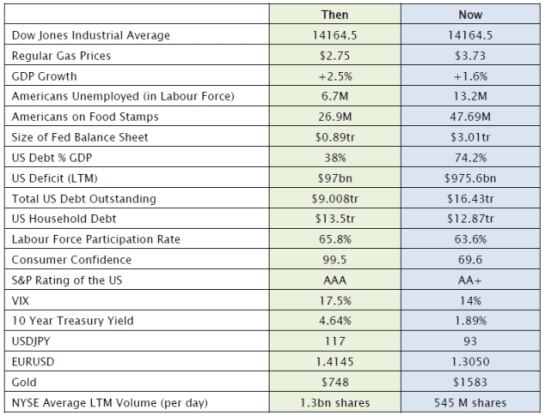
On 5 March 2013 the Dow Jones Industrial Average set a new all-time high, surpassing
the previous high of 14,165.50, established back in October 2007. Only the stock
market doesn’t seem to recognise that the world is a very different place today when
compared to 5 ½ years ago. Many investors talk the bearish talk, yet they walk the
bullish walk. This apparent inconsistency is a function of the widespread belief that
central bank policy, whether emanating from Tokyo, Frankfurt, London or
Washington, provides an effective volatility hedge, allowing investors to ignore the
underlying economic and financial problems that continue to simmer. Chart 1 landed
in my inbox a few weeks ago, courtesy of Simon Hunt. A chart often says more than a
thousand words; it certainly does in this case.

Chart 1: Now and Then – 2013 vs. 2007

4-4-2013 4-35-12 PM
Source: Charles de Trenck, Transport Trackers. U.S. data unless otherwise indicated.

The Comedy Called Cyprus

I have long argued that the creation of the European Monetary Union was akin to
reintroducing the gold standard. The eurozone member countries are effectively
locked into a system very similar to the one that proved so hopelessly inadequate
during the great depression in the early 1930s. A monetary union is quite simply the
wrong model for a rapidly ageing Europe, but a combination of ignorance and
stubbornness means that those in charge refuse to see the writing on the wall.

The last couple of weeks have provided ample evidence that the political leadership in Europe is utterly clueless as to how to resolve the crisis. If there were any trust left between the public and our elected leaders that has now been unequivocally broken with the disastrous handling of the crisis in Cyprus.

It is a well known fact that European banks depend more on deposits for their funding requirements whereas U.S. banks tend to primarily use capital markets. The fact that European policymakers were prepared to sacrifice small depositors in Cyprus demonstrates a shocking lack of knowledge of this reality. How do they think depositors in other eurozone countries will interpret this blatant attack on private savings? At a time where banks need access to funding more than ever? An invisible line in the sand has been crossed and there is no way back. Next time a bank in a major eurozone country runs into serious difficulties, there is likely to be a bank run, primarily because the trust was broken with the shambolic handling of events in Cyprus. As outgoing BoE Governor Mervyn King once quipped (and Iparaphrase): “It is irrational to start a bank run but, once it gets going, it is perfectly rational to join in.”

Triffin’s Dilema

The chronic U.S. current account deficits of the 1950s and 1960s created a build-up of substantial U.S. dollar reserves in Europe and Asia just like now. Unlike now, however, the creditor nations would redeem those dollars for gold, depleting U.S. gold reserves to the point where they became
dangerously low. Today’s creditor nations redeem their dollars for U.S. Treasuries
instead.

With the U.S. off the gold standard, the ability for the government to honour its
obligations in gold is no longer an issue. It is instead the future purchasing power of
U.S. Treasuries that is at stake; hence the system is still intrinsically unstable.

An Emerging Dollar Bull Market?

Central bankers around the world are obviously aware of all these issues and this is where the story gets interesting. In central bank circles there is a growing realisation that monetary policy as prescribed over the past few years has become largely ineffective. The Bank of England buying another batch of gilts or the Fed acquiring yet more Treasuries has simply lost its va-va-voom.
Central bankers are therefore beginning to realise that they are running out of options in terms of propping up the global economy and something altogether different shall be required. It is in that light that the rumour mill is working overtime. Would it be far-fetched to expect a globally coordinated initiative whereby central banks step in with a groundbreaking new plan as to how the global economy and monetary system should be run?

For that to occur, our political leaders would have to be forced into a corner. That could only happen if the financial system became overwhelmed by yet another crisis. Policy makers simply won’t make the difficult decisions unless there is no other choice. Following that logic, central bankers actually have an interest in, and could do the world a favour by, ‘creating’ another financial crisis. Religiously targeting ZIRP is a good starting point. Near zero percent interest rates encourage risk taking to the extreme as we have seen over the past few years. Extreme risk taking leads to asset bubbles which will ultimately feed a crisis somewhere.

You may think that I have lost my marbles. I am not so sure. None of this is taken out of thin air. I have friends and acquaintances in many strange places around the world and this has come through one of the more trusted channels. Will it happen? I honestly don’t know but it is probably the best shot we’ll have at profoundly changing the monetary infrastructure of the world and for precisely that reason I hope it does happen.

A slightly better chart than the one I posted in my Mt. Bernanke post:


“Bull markets are born on pessimism, grown on skepticism, mature on optimism and die on euphoria.”  -Sir John Templeton

Found via The Big Picture


The article this chart is from is worth a read: Stages in a Bubble – below is the introductory paragraph.

Business cycles are a well understood concept commonly linked with technological innovations, which are often triggering a phase of investment and new opportunities in terms of market and employment. The outcome is economic expansion and as the technology matures and markets become saturated, expansion slows down. A phase of recession is then a likely possibility as a correction is required to clear the excess investment or capacity that irremediably occur in the later stages of an economic cycle. The bottom line is that recessions are a normal condition to a market economy as they are regulating any excess, bankrupting the weakest players or those with the highest leverage. However, one of the mandates of central banking is to fight a process (business cycles) that occurs “naturally”. The interference of central banks such as the Federal Reserve appear to be exaggerating the amplitude of bubbles and the manias that fuel them. It could be argued that business cycles are being replaced by phases of booms and busts, which are still displaying a cyclic behavior, but subject to much more volatility. Although manias and bubbles have taken place many times before in history under very specific circumstances (Tulip Mania, South Sea Company, Mississippi Company, etc.), central banks appear to make matters worst by providing too much credit and being unable or unwilling to stop the process with things are getting out of control (massive borrowing). Instead of economic stability regulated by market forces, monetary intervention creates long term instability for the sake of short term stability.

There is a great article about Warren Buffett’s approach to investing from The American Association of Independent Investors (link).  The article is from January 1998 but the advice is timeless.  Below is a summary of his approach.  The article itself is a quick and easy read, well worth your time.

The Warren Buffett Approach

Philosophy and style
Investment in stocks based on their intrinsic value, where value is measured by the ability to generate earnings and dividends over the years. Buffett targets successful businesses—those with expanding intrinsic values, which he seeks to buy at a price that makes economic sense, defined as earning an annual rate of return of at least 15% for at least five or 10 years.

Universe of stocks
No limitation on stock size, but analysis requires that the company have been in existence for a considerable period of time.

Criteria for initial consideration
Consumer monopolies, selling products in which there is no effective competitor, either due to a patent or brand name or similar intangible that makes the product unique. In addition, he prefers companies that are in businesses that are relatively easy to understand and analyze, and that have
the ability to adjust their prices for inflation.

Other factors
• A strong upward trend in earnings
• Conservative financing
• A consistently high return on shareholder’s equity
• A high level of retained earnings
• Low level of spending needed to maintain current operations
• Profitable use of retained earnings

Valuing a Stock
Buffett uses several approaches, including:

  • Determining firm’s initial rate of return and its value relative to government bonds: Earnings per share for the year divided by the long-term government bond interest rate. The resulting figure is the relative value—the price that would result in an initial return equal to the return paid on government bonds.
  • Projecting an annual compounding rate of return based on historical earnings per share increases: Current earnings per share figure and the average growth in earnings per share over the past 10 years are used to determine the earnings per share in year 10; this figure is then multiplied by the average high and low price-earnings ratios for the stock over the past 10 years to provide an estimated price range in year 10. If dividends are paid, an estimate of the amount of dividends paid over the 10-year period should also be added to the year 10 prices.

Stock monitoring and when to sell
Does not favor diversification; prefers investment in a small number of companies that an investor can know and understand extensively. Favors holding for the long term as long as the company remains “excellent”—it is consistently growing and has quality management that operates for the benefit of shareholders. Sell if those circumstances change, or if an alternative investment offers a better return.

On Sunday the NYT ran an interesting op-ed by former Congressmen and Reagan’s budget director, David Stockman.  The article has an extremely pessimistic outlook for our country and economy; you might even think you were reading Zero Hedge and not the NYT (the only difference is Stockman recommends holding cash as opposed to gold).

He highlights some huge problems facing our nation – the most discouraging is our government’s inability to do anything about them.  Below are a few paragraphs that sum things up.  The whole article is worth your time and attention (link).


The future is bleak. The greatest construction boom in recorded history — China’s money dump on infrastructure over the last 15 years — is slowing. Brazil, India, Russia, Turkey, South Africa and all the other growing middle-income nations cannot make up for the shortfall in demand. The American machinery of monetary and fiscal stimulus has reached its limits. Japan is sinking into old-age bankruptcy and Europe into welfare-state senescence. The new rulers enthroned in Beijing last year know that after two decades of wild lending, speculation and building, even they will face a day of reckoning, too.

THE state-wreck ahead is a far cry from the “Great Moderation” proclaimed in 2004 by Mr. Bernanke, who predicted that prosperity would be everlasting because the Fed had tamed the business cycle and, as late as March 2007, testified that the impact of the subprime meltdown “seems likely to be contained.” Instead of moderation, what’s at hand is a Great Deformation, arising from a rogue central bank that has abetted the Wall Street casino, crucified savers on a cross of zero interest rates and fueled a global commodity bubble that erodes Main Street living standards through rising food and energy prices — a form of inflation that the Fed fecklessly disregards in calculating inflation.

These policies have brought America to an end-stage metastasis. The way out would be so radical it can’t happen. It would necessitate a sweeping divorce of the state and the market economy. It would require a renunciation of crony capitalism and its first cousin: Keynesian economics in all its forms. The state would need to get out of the business of imperial hubris, economic uplift and social insurance and shift its focus to managing and financing an effective, affordable, means-tested safety net.

All this would require drastic deflation of the realm of politics and the abolition of incumbency itself, because the machinery of the state and the machinery of re-election have become conterminous. Prying them apart would entail sweeping constitutional surgery: amendments to give the president and members of Congress a single six-year term, with no re-election; providing 100 percent public financing for candidates; strictly limiting the duration of campaigns (say, to eight weeks); and prohibiting, for life, lobbying by anyone who has been on a legislative or executive payroll. It would also require overturning Citizens United and mandating that Congress pass a balanced budget, or face an automatic sequester of spending.

It would also require purging the corrosive financialization that has turned the economy into a giant casino since the 1970s. This would mean putting the great Wall Street banks out in the cold to compete as at-risk free enterprises, without access to cheap Fed loans or deposit insurance. Banks would be able to take deposits and make commercial loans, but be banned from trading, underwriting and money management in all its forms.

It would require, finally, benching the Fed’s central planners, and restoring the central bank’s original mission: to provide liquidity in times of crisis but never to buy government debt or try to micromanage the economy. Getting the Fed out of the financial markets is the only way to put free markets and genuine wealth creation back into capitalism.

That, of course, will never happen because there are trillions of dollars of assets, from Shanghai skyscrapers to Fortune 1000 stocks to the latest housing market “recovery,” artificially propped up by the Fed’s interest-rate repression. The United States is broke — fiscally, morally, intellectually — and the Fed has incited a global currency war (Japan just signed up, the Brazilians and Chinese are angry, and the German-dominated euro zone is crumbling) that will soon overwhelm it. When the latest bubble pops, there will be nothing to stop the collapse. If this sounds like advice to get out of the markets and hide out in cash, it is.