A fascinating approach to the hierarchy of innovation based on Maslow’s hierarchy of needs.  Go check out the full post at Rough Type.

hierarchy of innovation“The focus, or emphasis, of innovation moves up through five stages, propelled by shifts in the needs we seek to fulfill. In the beginning come Technologies of Survival (think fire), then Technologies of Social Organization (think cathedral), then Technologies of Prosperity (think steam engine), then technologies of leisure (think TV), and finally Technologies of the Self (think Facebook, or Prozac).”

***

“One of the consequences is that, as we move to the top level of the innovation hierarchy, the inventions have less visible, less transformative effects. We’re no longer changing the shape of the physical world or even of society, as it manifests itself in the physical world. We’re altering internal states, transforming the invisible self. Not surprisingly, when you step back and take a broad view, it looks like stagnation – it looks like nothing is changing very much.”

Source: Rough Type

Found via The Big Picture


Below is a chart of the 50 biggest companies that spent the most on R&D – courtesy of the The 2013 EU Industrial R&D Scoreboard.

I was a little surprised to see Volkswagen at the top.  I was also surprised to see Apple come in at #46.  I suppose it is more expensive to make advancements on large durable goods like cars than consumer hardware & software (but Microsoft is #3…).  It’s also worth noting that this only shows how much was spent – not how much was gained or returned on that investment.  For many this could be a case of “all thrust and not vector”.the 2013 eu industrial r&d investment scoreboard


Found via Business Insider

Interesting read from the WSJ about how horizontal drilling technology is breathing new life into an old Texas oil field.  I especially like their graphic…

I still want to know how on earth you drill horizontally but I don’t have time for an extended wikipedia worm-hole session today.

From the WSJ: Second Life for an Old Oil Field

One of Texas’ oldest oil fields, in decline for decades, has become one of the hottest places in the country to drill for crude, as energy companies create clusters of wells with layers of horizontal branches.

The Permian Basin—86,000 square miles centered on Midland, Texas—has been pumping oil since the 1920s, though production peaked at about 2 million barrels a day in the early 1970s. For decades, geologists have known that oil could be found in different layers of rock piled up like a stack of geologic pancakes.

But now drillers are starting to tap those layers simultaneously from a single site—and are committing billions of dollars to do so.


MK-CH988_PERMIA_G_20131119180309

I’ve posted this quote before but it bears repeating:

“For as long as I can remember, veteran businessmen and investors – I among them – have been warning about the dangers of irrational stock speculation and hammering away at the theme that stock certificates are deeds of ownership and not betting slips… The professional investor has no choice but to sit by quietly while the mob has its day, until the enthusiasm or panic of the speculators and non-professionals has been spent. He is not impatient, nor is he even in a very great hurry, for he is an investor, not a gambler or a speculator. The seeds of any bust are inherent in any boom that outstrips the pace of whatever solid factors gave it its impetus in the first place. There are no safeguards that can protect the emotional investor from himself.”

Source: John Hussman by way of Value Investing World 

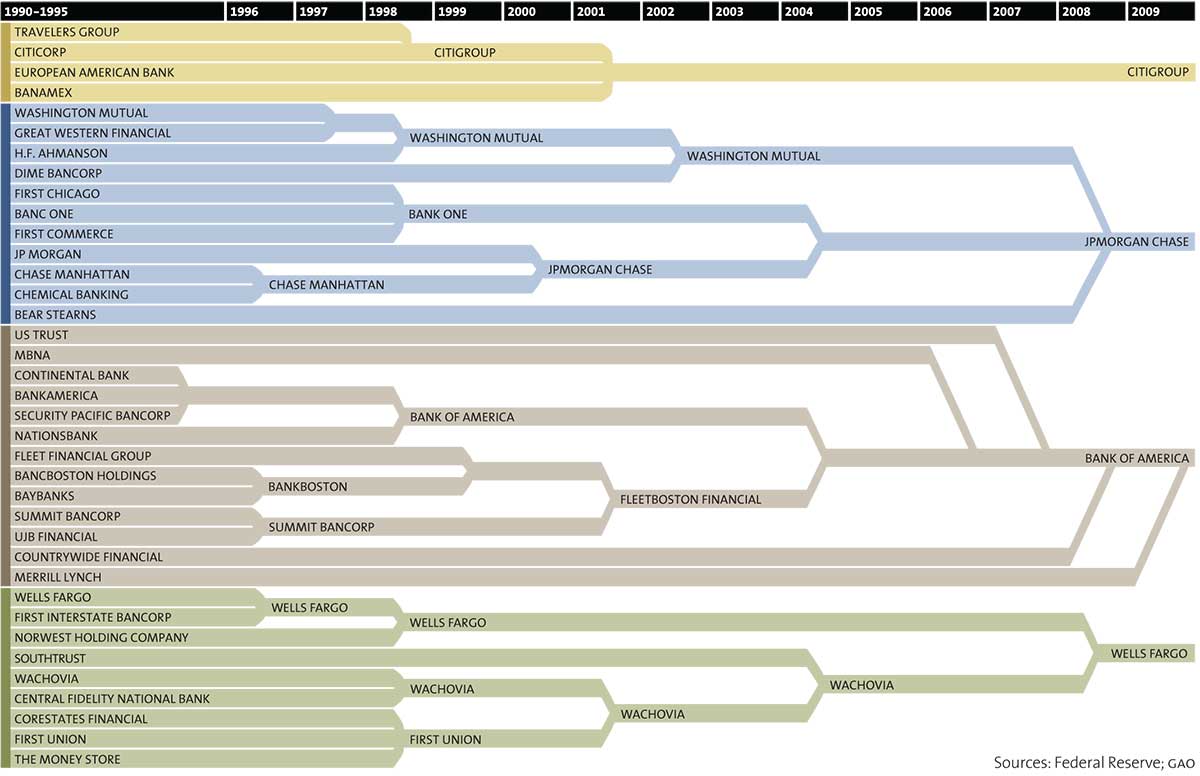
Presenting the family tree of systemically important, Too Big To Fail banks.  Usually family trees grow up and out – not the case with banks.

We’ve come a long way from the early 1990s when risks were relatively compartmentalized and spread across a few dozen institutions.  Sure the risks become more concentrated among fewer institutions but think of all the synergies that will be realized and think of all the shareholder value that will be created!

This reminds me of an old saying about eggs in a basket but I can’t remember how it goes…

Too_big_to_fail

Found via The Big Picture