Archive

Business

Simon Sinek: How great leaders inspire action

I’ve been periodically watching this video for a few years and I’ve been meaning to blog about it for quite a while.  This 20 minute talk is well worth your time – the concept is simple but resonates incredibly well.

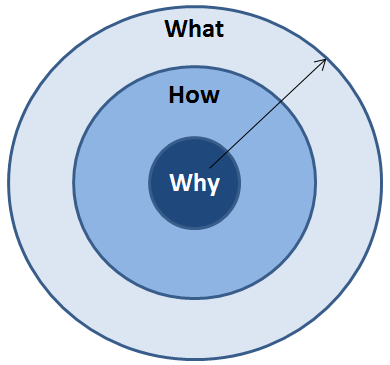
The punchline: why you do something is more important than what you do or how you do it.  That’s not to say the “how” or “what” aren’t important but it’s the “why” that ranks supreme.  People don’t buy what you do, they buy why you do it.

There are leaders and there are those who lead.  Leaders are people with power and authority, we follow them because we have to.  Those who lead inspire us, we follow them because we want to.

The Golden Circle

goldencircle

Interesting NYT article about some new crowdfunding platforms that let smaller investors invest in commercial real estate projects.  Not a lot of detail about the finer points of the investment are offered up (like can you sell your interest and get your money back?  When?) but it seems like an elegant way to invest in real estate.  I’ve been a long time investor through Lending Club and this is basically the same model but with different underlying investment characteristics.

The democratization of community development was one aspect of the article that really struck me.  This would be a cool mechanism to allow people to invest locally in real estate and have some influence in shaping their community (as opposed to REITs or PE shops based elsewhere).

I’m not sure it pays to be one of the earliest adopters of these real estate platforms but I think they’re worth keeping an eye on / studying further.

The platforms: Fundrise and Realty Mogul

Probably the best 11 minutes you’ll spend all week….


On share price volatility:

  • There have been three times Munger / Buffett have seen their holdings in Berkshire go down 50% (top tick to bottom tick)
  • Volatility is in the nature of long-term shareholding – if you’re not willing to react with equanimity to drastic declines you don’t deserve to do as well as the long-term holders that do
  • It’s a temperament, one needs to be more philosophical about market fluctuations

How political ideology caused the markets to crash:

  • Can never take all the boom and bust out of a capitalist economy but they could be considerably dampened if there were certain wise restraints
  • The folks that made a lot of money due to the lack of wise restraints channeled their resources to lobby for even less restraints – aided by ideological nuttiness that assumes because free markets work so well compared to communism, it follows that no laws at all will work even better – not true, the economy will work worse if you don’t have any wise restraints

The idiot boom and the fringes of the US Democrat and Republican Parties

  • Both parties have wings that are full of idiots – that’s the nature of the game
  • The people in the middle usually can tune out the idiots and do pretty well but every once in a while the idiots get in control
  • Compares the idiot boom (the idiot expansion of consumer credit) to going on Heroine – your life would be pleasant for a few weeks but it will ultimately totally destroy you

On Alan Greenspan

  • To his credit, of all the major figures, he’s the only one that promptly said “I’m a horse’s ass”

The trouble with Wall Street culture

  • Wall Street attracts and rewards a “locker room culture” – people that just have to win.  They’re so competitive that whatever “A” is doing they have to be better than “A”
  • They’re not very squeamish about what they have to do to win and thus are willing to do enormous damage to the rest of us in order to win

Munger and Buffett’s checklist for picking a company to invest in

  • First filter: must deal in things they’re capable of understanding
  • Next, the business must have some intrinsic characteristics that give it a durable competitive advantage
  • Vastly prefer a management in place with a lot of integrity and talent
  • Finally, no matter how wonderful it is, its not worth an infinite price – must have a price that makes sense and provides a margin of safety
  • It’s a very simple set of ideas – they’re too simple – the professional classes can’t justify their existence if that’s all they have to do – it’s so obvious, so simple, what would they have to do with the rest of the semester?

Munger’s way of thinking about buying shares

  • We have the mindset of the person buying the whole business
  • We like buying individual shares at a price that’s lower than what we think a rational person would pay if he could buy the whole business

It’s been a while since I posted about one of my all time favorite people in this world, Jeremy Grantham.  There are two interesting articles from a sit down chat Leo Hickman had with Grantham. The topic was the environment, and Grantham’s efforts to help save it.  The first article is a summary version from The Guardian.  The second article is the full length interview from Business Insider.

As usual you’ll find my favorite excerpts below.  I especially like his balanced view that oil and gas aren’t entirely bad.  It’s a nuanced opinion but he has a point – for now they’re a necessary evil; try taking them away tomorrow and see what happens.

Part I: Jeremy Grantham, environmental philanthropist: ‘We’re trying to buy time for the world to wake up’ (The Guardian)

Part II: GRANTHAM: Capitalism Is Great, But It Assigns No Value To Your Grandchildren (Business Insider)

Excerpts from Part I:

Many deep-greens – who claim the root cause for our environmental woes is the slavish quest for economic growth – will recoil at the thought of a hard-boiled capitalist such as Grantham underpinning so much of the environmental movement. He is unconcerned. “Capitalism does millions of things better than the alternatives. It balances supply and demand in an elegant way that central planning has never come close to. However, it is totally ill-equipped to deal with a small handful of issues. Unfortunately, they are the issues that are absolutely central to our long-term wellbeing and even survival.”

More awkwardly, he insists his substantial investments in oil and gas don’t contradict his green views. “We need oil. If we took oil away tomorrow, civilisation ends. We can burn all the cheap, high-quality oil and gas, but if we mean to burn all the coal and any appreciable percentage of the tar sands, or even third-derivative, energy-intensive oil and gas, with ‘fracking’ for shale gas on the boundary, then we’re cooked, we’re done for.”

***

But “China is my secret weapon,” he says enthusiastically. His eyes widen with excitement, and he talks quicker and quicker. “The Chinese cavalry riding to the rescue. I have very high hopes for China because they have embedded high scientific capabilities in their leadership class. They know this is serious. And they are acting much faster now than we are. They have it within their capabilities to come back in 30 years with the guarantee of complete energy independence – all alternative and sustainable for ever. They have an embarrassment of capital. We have an embarrassment of debt. So they can set a stunning pace, which they are doing. And they could crank it up. To hell with their five-year plans, they should move up to 25-year plans. They would have such low-cost energy at the end of it they’d be the terror of the capitalist system. Low energy and low labour, that’s the ball game.”

But he argues that there is no reason why the west can’t compete. “Anyone who says government can’t do this, or can’t do that, I say a pox on you; have a look at the Manhattan Project. They did remarkable things. They stuck the brightest minds out in the desert. They were herding cats with great egos, but it worked. If we did that on alternative energy, we’d be home free.”

Excerpts from Part II:

[Continuing his point on where capitalism fails us…]

Unfortunately, today, they are the issues that are absolutely central to our long-term wellbeing and even survival. It doesn’t think long-term very well because of high discount rate structure.

If you’re a typical corporation anything lying out 30 years literally doesn’t matter. Or, as I like to say: QED, your grandchildren have no value. And they usually act as if that was true, even though I’m sure they are actually very kind to their grandchildren.

***

It has been remarked before that modern economics is belief in a perpetual motion machine. Capital and labour, but no mention of energy. Without energy the whole thing grinds to a halt and the whole theory is demonstrated to be totally false. I’m late in the game at recognising this.

One of my new heroes is an economist called Kenneth Boulding who, at 22, got a paper into Keynes‘s journal. At the age of about 50 he realised that economics was not taking its job seriously, that it was not interested in utility, in real serious improvement in the world, but that it was increasingly interested in new, elegant mathematical theories designed to get career advancement, over usefulness.

He said the only people who believe you can have compound growth in a finite world are either mad men or economists. He also said: “Mathematics has brought rigor to economics. Unfortunately, it also brought mortis.”


The Series A Crunch is a hot topic in Silicon Valley.  The overall premise is that the recent boom in early stage seed investments will result in a lot of dead or dying companies that don’t live to see a Series A investment.  Some of these companies may be valuable, whether its their team, IP, or something else.

Earlier this month a list of these companies was available for purchase for $5,000.  The fine folks over at TechCrunch / CrunchBase have put together their own list of nearly 1,300 companies available for free here.

Below is their approach / criteria for identifying these companies.  This is truly akin to panning for gold.

mining_series_a_crunch

  • Start with US companies that closed a seed (or angel) round on or after Jan 1, 2011
  • Exclude companies that have received follow on funding
  • Exclude companies that were acquired
  • Exclude companies without news or employee updates in last 6 months
  • Exclude companies known to have closed
  • Look at remaining companies where it’s been ~13 months since their last funding

Source: CruncBase blog