arsenal-of-democracy-logo_0

Today, the great city of Detroit turns 313 years old.  As fate would have it I also recently read about the origins of Detroit’s motto:

“Speramus meliora; resurget cineribus” or “We hope for better things; it will arise from the ashes”

The motto, first uttered in 1805, is eerily fitting for the city today.

The full story of the motto’s origin comes from the WSJ:

That motto, Detroit’s, comes from a French Roman Catholic priest, Father Gabriel Richard. He was born in France in 1767 and moved to Baltimore in 1792 to teach math. Reassigned to do missionary work, he moved first to Illinois and later to Detroit, where he was the assistant pastor at St. Anne’s Church.

St Anne’s Church, in the southwest part of the city, stands between Michigan Central Station and the Ambassador Bridge. It was founded in 1701 and could be the oldest continuously operating Roman Catholic parish in the U.S.

On June 11, 1805, a fire destroyed nearly the entire city, weeks before the Michigan Territory was established. It was that fire that led Mr. Richard to write: “Speramus meliora; resurget cineribus.”


nowheretoputyourmoney

“In Spain, where there was a debt crisis just two years ago, investors are so eager to buy the government’s bonds that they recently accepted the lowest interest rates since 1789.”

“In France, a cable-television company called Numericable was recently able to borrow $11 billion, the largest junk bond deal on record — and despite the risk usually associated with junk bonds, the interest rate was a low 4.875 percent.”

“Welcome to the Everything Boom — and, quite possibly, the Everything Bubble. Around the world, nearly every asset class is expensive by historical standards. Stocks and bonds; emerging markets and advanced economies; urban office towers and Iowa farmland; you name it, and it is trading at prices that are high by historical standards relative to fundamentals. The inverse of that is relatively low returns for investors.”

Source: Welcome to the Everything Boom, or Maybe the Everything Bubble 

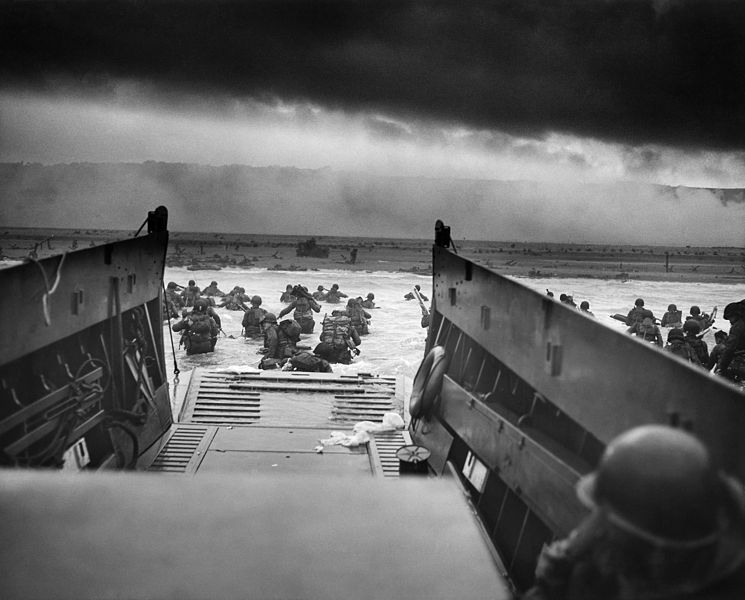
Operation Overlord: Order of the Day

Supreme Headquarters 
Allied Expeditionary Force

Soldiers, Sailors and Airmen of the Allied Expeditionary Force!

You are about to embark upon the Great Crusade, toward which we have striven these many months. The eyes of the world are upon you. The hopes and prayers of liberty-loving people everywhere march with you. In company with our brave Allies and brothers-in-arms on other Fronts, you will bring about the destruction of the German war machine, the elimination of Nazi tyranny over the oppressed peoples of Europe, and security for ourselves in a free world.

Your task will not be an easy one. Your enemy is well trained, well equipped and battle hardened. He will fight savagely.

But this is the year 1944 ! Much has happened since the Nazi triumphs of 1940-41. The United Nations have inflicted upon the Germans great defeats, in open battle, man-to-man. Our air offensive has seriously reduced their strength in the air and their capacity to wage war on the ground.

Our Home Fronts have given us an superiority in weapons and munitions of war, and placed at our disposal great reserves of trained fighting men. The tide has turned! The free men of the world marching together to Victory!

I have full confidence in your devotion to duty and skill in battle.
We will accept nothing less than full Victory!

Good Luck! And let us all beseech blessing of Almighty God upon this great and noble undertaking.

-General of the Army Dwight D. Eisenhower
Supreme Allied Commander

745px-Into_the_Jaws_of_Death_23-0455M_edit

Just to prove that no technology is immune from disruption one of the oldest technologies in the book is being disrupted: the act of reading. (Pun intended).  Reading is so old and so fundamental it’s awkward to think of reading as a form of technology.  Perhaps there’s a better term for it?  I digress.

Not many people will tell you that reading is a waste of time but the folks at Spritz might.  According to the company, “when reading, only around 20% of your time is spent processing content. The remaining 80% is spent physically moving your eyes from word to word”.  Spritz has found a way to avoid all that wasted time.

Spritz’s technology streams words at a customizable rate ranging from 250 to 1,000 words per minute.  Instead of reading, you’re “spritzing”.  Take a look at the example below – it’s streaming 500 words per minute.

3027008-inline-56tvouk

I’m pretty sure this is the last stop before they can just mainline knowledge right to your brain (a la Matrix).

More information available at spritzinc.com

Found via FastCompany