Archive

Economics

The Absolute Return Letter: The Need for Wholesale Change

A good read about the state of the markets.  Below you’ll find a hodgepodge of excerpts I found interesting – read the letter in its entirety for a more coherent argument.  Note: everything you read below is a directly quoted excerpt.

Intro & Chart:

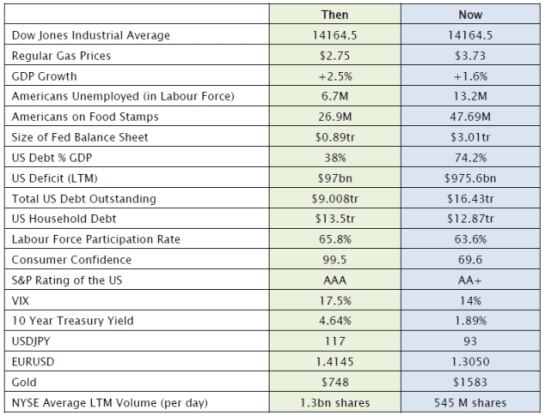
On 5 March 2013 the Dow Jones Industrial Average set a new all-time high, surpassing
the previous high of 14,165.50, established back in October 2007. Only the stock
market doesn’t seem to recognise that the world is a very different place today when
compared to 5 ½ years ago. Many investors talk the bearish talk, yet they walk the
bullish walk. This apparent inconsistency is a function of the widespread belief that
central bank policy, whether emanating from Tokyo, Frankfurt, London or
Washington, provides an effective volatility hedge, allowing investors to ignore the
underlying economic and financial problems that continue to simmer. Chart 1 landed
in my inbox a few weeks ago, courtesy of Simon Hunt. A chart often says more than a
thousand words; it certainly does in this case.

Chart 1: Now and Then – 2013 vs. 2007
4-4-2013 4-35-12 PM
Source: Charles de Trenck, Transport Trackers. U.S. data unless otherwise indicated.

The Comedy Called Cyprus

I have long argued that the creation of the European Monetary Union was akin to
reintroducing the gold standard. The eurozone member countries are effectively
locked into a system very similar to the one that proved so hopelessly inadequate
during the great depression in the early 1930s. A monetary union is quite simply the
wrong model for a rapidly ageing Europe, but a combination of ignorance and
stubbornness means that those in charge refuse to see the writing on the wall.

The last couple of weeks have provided ample evidence that the political leadership in Europe is utterly clueless as to how to resolve the crisis. If there were any trust left between the public and our elected leaders that has now been unequivocally broken with the disastrous handling of the crisis in Cyprus.

It is a well known fact that European banks depend more on deposits for their funding requirements whereas U.S. banks tend to primarily use capital markets. The fact that European policymakers were prepared to sacrifice small depositors in Cyprus demonstrates a shocking lack of knowledge of this reality. How do they think depositors in other eurozone countries will interpret this blatant attack on private savings? At a time where banks need access to funding more than ever? An invisible line in the sand has been crossed and there is no way back. Next time a bank in a major eurozone country runs into serious difficulties, there is likely to be a bank run, primarily because the trust was broken with the shambolic handling of events in Cyprus. As outgoing BoE Governor Mervyn King once quipped (and Iparaphrase): “It is irrational to start a bank run but, once it gets going, it is perfectly rational to join in.”

Triffin’s Dilema

The chronic U.S. current account deficits of the 1950s and 1960s created a build-up of substantial U.S. dollar reserves in Europe and Asia just like now. Unlike now, however, the creditor nations would redeem those dollars for gold, depleting U.S. gold reserves to the point where they became
dangerously low. Today’s creditor nations redeem their dollars for U.S. Treasuries
instead.

With the U.S. off the gold standard, the ability for the government to honour its
obligations in gold is no longer an issue. It is instead the future purchasing power of
U.S. Treasuries that is at stake; hence the system is still intrinsically unstable.

An Emerging Dollar Bull Market?

Central bankers around the world are obviously aware of all these issues and this is where the story gets interesting. In central bank circles there is a growing realisation that monetary policy as prescribed over the past few years has become largely ineffective. The Bank of England buying another batch of gilts or the Fed acquiring yet more Treasuries has simply lost its va-va-voom.
Central bankers are therefore beginning to realise that they are running out of options in terms of propping up the global economy and something altogether different shall be required. It is in that light that the rumour mill is working overtime. Would it be far-fetched to expect a globally coordinated initiative whereby central banks step in with a groundbreaking new plan as to how the global economy and monetary system should be run?

For that to occur, our political leaders would have to be forced into a corner. That could only happen if the financial system became overwhelmed by yet another crisis. Policy makers simply won’t make the difficult decisions unless there is no other choice. Following that logic, central bankers actually have an interest in, and could do the world a favour by, ‘creating’ another financial crisis. Religiously targeting ZIRP is a good starting point. Near zero percent interest rates encourage risk taking to the extreme as we have seen over the past few years. Extreme risk taking leads to asset bubbles which will ultimately feed a crisis somewhere.

You may think that I have lost my marbles. I am not so sure. None of this is taken out of thin air. I have friends and acquaintances in many strange places around the world and this has come through one of the more trusted channels. Will it happen? I honestly don’t know but it is probably the best shot we’ll have at profoundly changing the monetary infrastructure of the world and for precisely that reason I hope it does happen.

On Sunday the NYT ran an interesting op-ed by former Congressmen and Reagan’s budget director, David Stockman.  The article has an extremely pessimistic outlook for our country and economy; you might even think you were reading Zero Hedge and not the NYT (the only difference is Stockman recommends holding cash as opposed to gold).

He highlights some huge problems facing our nation – the most discouraging is our government’s inability to do anything about them.  Below are a few paragraphs that sum things up.  The whole article is worth your time and attention (link).


The future is bleak. The greatest construction boom in recorded history — China’s money dump on infrastructure over the last 15 years — is slowing. Brazil, India, Russia, Turkey, South Africa and all the other growing middle-income nations cannot make up for the shortfall in demand. The American machinery of monetary and fiscal stimulus has reached its limits. Japan is sinking into old-age bankruptcy and Europe into welfare-state senescence. The new rulers enthroned in Beijing last year know that after two decades of wild lending, speculation and building, even they will face a day of reckoning, too.

THE state-wreck ahead is a far cry from the “Great Moderation” proclaimed in 2004 by Mr. Bernanke, who predicted that prosperity would be everlasting because the Fed had tamed the business cycle and, as late as March 2007, testified that the impact of the subprime meltdown “seems likely to be contained.” Instead of moderation, what’s at hand is a Great Deformation, arising from a rogue central bank that has abetted the Wall Street casino, crucified savers on a cross of zero interest rates and fueled a global commodity bubble that erodes Main Street living standards through rising food and energy prices — a form of inflation that the Fed fecklessly disregards in calculating inflation.

These policies have brought America to an end-stage metastasis. The way out would be so radical it can’t happen. It would necessitate a sweeping divorce of the state and the market economy. It would require a renunciation of crony capitalism and its first cousin: Keynesian economics in all its forms. The state would need to get out of the business of imperial hubris, economic uplift and social insurance and shift its focus to managing and financing an effective, affordable, means-tested safety net.

All this would require drastic deflation of the realm of politics and the abolition of incumbency itself, because the machinery of the state and the machinery of re-election have become conterminous. Prying them apart would entail sweeping constitutional surgery: amendments to give the president and members of Congress a single six-year term, with no re-election; providing 100 percent public financing for candidates; strictly limiting the duration of campaigns (say, to eight weeks); and prohibiting, for life, lobbying by anyone who has been on a legislative or executive payroll. It would also require overturning Citizens United and mandating that Congress pass a balanced budget, or face an automatic sequester of spending.

It would also require purging the corrosive financialization that has turned the economy into a giant casino since the 1970s. This would mean putting the great Wall Street banks out in the cold to compete as at-risk free enterprises, without access to cheap Fed loans or deposit insurance. Banks would be able to take deposits and make commercial loans, but be banned from trading, underwriting and money management in all its forms.

It would require, finally, benching the Fed’s central planners, and restoring the central bank’s original mission: to provide liquidity in times of crisis but never to buy government debt or try to micromanage the economy. Getting the Fed out of the financial markets is the only way to put free markets and genuine wealth creation back into capitalism.

That, of course, will never happen because there are trillions of dollars of assets, from Shanghai skyscrapers to Fortune 1000 stocks to the latest housing market “recovery,” artificially propped up by the Fed’s interest-rate repression. The United States is broke — fiscally, morally, intellectually — and the Fed has incited a global currency war (Japan just signed up, the Brazilians and Chinese are angry, and the German-dominated euro zone is crumbling) that will soon overwhelm it. When the latest bubble pops, there will be nothing to stop the collapse. If this sounds like advice to get out of the markets and hide out in cash, it is.

Below are a few excerpts from Tim Duy’s article about the strength of the economic recovery.  Go check out the full article, charts included, here.

The economy has proved to be very resilient.  We have weathered external demand shocks, external financial crises, and even fiscal contraction, and all the while economic activity continued to grind higher.  Looking back, it seems that the biggest risk the economy faced was the Fed’s start/stop approach to quantitative easing.  That problem appears solved with open-ended QE linked to economic guideposts.

At the risk of sounding overly optimistic, I am going to go out on a limb:  The recovery is here to stay.  Not “stay” as in “permanent.”  I am not predicting the end of the business cycle.  But “stay” until some point after the Federal Reserve begins to raise interest rates, which I don’t expect until 2015. This doesn’t mean you need to be happy about the pace of growth.  But it does mean that a US recession in the next three years should be pretty far down on your list of concerns.

His take is based on strength in (1) industrial production, (2) retail sales, (3) the housing market, and (4) employment.

What does this mean for the market?  Good question, nobody can be sure – but its certainly possible to see equities contract while the underlying economy continues to improve.  Just read the previous posts highlighting John Hussman’s bearish take on the markets.  Whatever the markets do, lets hope the economic recovery stays intact and at least provides a buoy should Mr. Market freak out.

Also, lets take into account the forward looking nature of equities, after all any real investor worrying about fundamentals should be thinking a minimum of 3-5 years out (despite the majority of Wall Street focusing on the next quarter or two).  This will put fundamental / value investors in the uncomfortable position of factoring in the Fed’s exit well ahead of the rest of the market, if not already.

Tim’s bottom line:

Bottom Line:  The US economy is less fragile than commonly believed; it has endured a series of shocks over the last three years without major incident.   I am claiming neither that equity prices won’t stumble, nor that we should be happy with the pace of activity.  But I do think that a recession is unlikely before the Federal Reserve begins raising interest rates – something not likely to happen for two years.  While long-run predictions are dangerous, for the sake of argument add up to another two years for tighter policy to reverberate through the economy and you are looking at sometime around 2016/2017 when the next recession hits.  That’s the timeframe I am currently thinking about.

Last week I highlighted John Hussman’s contrarian view of the market.  Hussman’s market commentary this week is full of more pearls of wisdom that are worth highlighting.  And no, he has not turned bullish:

The present environment is characterized by unusually overvalued, overbought, overbullish conditions, with rising 10-year Treasury bond yields, heavy insider selling, valuations on “forward earnings” appearing reasonable only because profit margins are more than 70% above historical norms (fully explained by the negative sum of government and personal savings as a share of GDP), with the S&P 500 at a 4-year market high, in a mature market advance, with lagging employment indicators still positive but more than half of all OECD countries already in GDP contraction, Europe in recession, Britain on the cusp, and the EU imposing massive losses on depositors in order to protect lenders in an unstable banking system where Cyprus is the iceberg’s tip. Investors have assumed a direct link between money creation and stock market performance, where provoking yield-seeking and discomfort among conservative investors is the only transmission mechanism of a nearly-insolvent Fed. Investors have assumed that stocks can be properly valued on the basis of a single year of earnings reflecting the benefit of massive fiscal deficits, depressed household saving, and extraordinary monetary distortion – when the more relevant long-term stream of earnings will enjoy far less benefit. Historically, extreme overvalued, overbought, overbullish, rising-yield syndromes have outweighed both trend-following and monetary factors, on average. For defensiveness to be inappropriate even in this environment, investors must rely on the present instance to be a radical outlier.

I especially like his notion of “The Hook”, a term that appears to be coined by Richard Russell:

“Every bull and bear market needs a ‘hook.’ The hook in a bear market is whatever the bear serves to keep investors and traders thinking that everything is going to be all right. There is always a hook.” – Richard Russell, Dow Theory Letters, November 2000 (S&P 1400)

The “hook” today is the dramatically elevated, deficit-induced level of profit margins. While the complete faith of investors in the Federal Reserve may prove to be the hook for ordinary investors, it’s not enough to draw in more careful observers. The real hook, in my view, is the absence of a bubble in any individual sector, and instead a bubble in profit margins across the entire corporate sector. That is the hook that serves to keep investors and traders thinking that everything is going to be all right.

Buyer beware.  Do yourself a favor and go read the entire piece here.


For those of you who don’t stay up to date on Ag related investing, farmland has been absolutely killing it:

There are a few structural drivers behind this and it’s expected they’ll remain strong tailwinds for the asset class:

  • Global Population continues to increase – more mouths to feed (increasing demand)
  • Maxed out Crop Yields – for a long time the amount of crops we were able to grow per acre of land increased with population growth – we became expert farmers and were able to squeeze more and more out of the land (see chart below – this also explains why everything you eat today is made from corn) that increase in yield is starting to stall (squeezing supply)
  • Reduction in arable land due to development (squeezing supply)

So how do you get on the Farmland gravy train?  Besides buying a farm outright you can invest through the new platform Fquare.  It appears to be a crowdfunding platform designed to give accredited investors diversified exposure to US farmland.  Unfortunately their website falls well short of answering even the most basic questions of how the platform works.

I don’t know enough about Fquare to endorse it or not – I only mention it here because (1) it appears to be a cool confluence of agriculture and technology, and (2) I haven’t posted anything about Ag investing until now.

Every Monday, John Hussman publishes incredibly robust market commentary.  He has become increasingly bearish as the equity rally we’ve seen since March 2009 steams forward.  His latest market commentary Investment, Speculation, Valuation, and Tinker Bell is no exception.  What sets Dr. Hussman apart from most market pundits is the amount of data and analysis he brings to the table – it’s often times overwhelming and probably too much for your weekend investor to get through.

In his latest commentary he provides an interesting quote from Buffett:

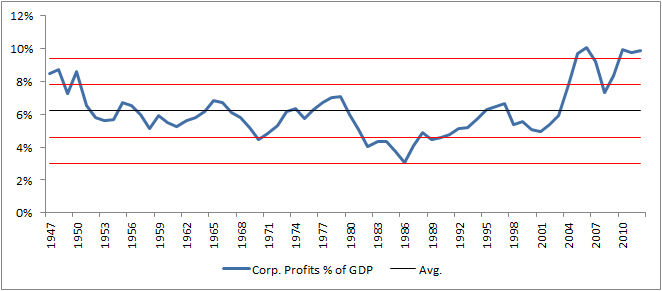
Warren Buffett was correct about profits as a share of GDP in November 1999 (and it would be useful if he remembered today how correct he was): “In my opinion, you have to be wildly optimistic to believe that corporate profits as a percent of GDP can, for any sustained period, hold much above 6%… Maybe you’d like to argue a different case. Fair enough. But give me your assumptions. The Tinker Bell approach – clap if you believe – just won’t cut it.”

This quote caught my eye.  Using the incredibly handy FRED database excel plug-in, I decided to test this statement.  Below is a chart depicting Corporate Profits After Tax as a percentage of Nominal GDP.  Buffett was dead on with his 6% remark – since 1947 this measurement has averaged 6.1% through 2011.  In the chart below I assumed corporate profit growth of 5% for 2012 (I’m not sure what that number actually was but this is a quick and dirty analysis).  The result: corporate profits are extremely elevated compared to GDP, 2.3 standard deviations above the average if you use my 5% assumption for 2012, 2.2 standard deviations if you just look at 2011 as the latest.  Ironically it was right around 1999, when Buffett made that statement, that corporate profits as a % of GDP bottomed out and began their sustained run above 6%.

 Corp Profits % of GDP

Although I don’t have the data, I searched for “Corporate Profit Margins” and found many charts that looked like the one below.  The embedded Grantham quote is just icing on the cake, if you can read it (I didn’t actually notice it until I pasted it into this post, score).

Some have pontificated that higher profit margins are the result of broader international activity among corporations and are here to stay – Hussman, who has done is homework, has found no convincing evidence of that.  In an earlier commentary he points out that “Elevated corporate profits can be directly traced to the massive government deficit and depressed household savings that we presently observe… one will not be permanent without the other being permanent… any normalization in the sum of government and household savings is likely to be associated with a remarkably deep decline in corporate earnings

SO – what gives?  Probably corporate profit margins but WHEN that happens is anyone’s guess.

…and that is your contrarian view of the markets, thanks for joining.

P.S. Hussman’s commentary from the week before addresses the subject of corporate profit margins in much greater detail, including a version of the chart I so cleverly put together.  Unfortunately I read his posts in reverse chronological order.  For a much deeper dive on the subject read his Two Myths and a Legend post.

Anyone who follows this blog knows I’m a HUGE fan of Jeremy Grantham.  He is an incredibly smart man and has the added benefit of being English, so even if you find the substance of his discussions to be boring you can at least enjoy his accent.  You should read his quarterly letters over at GMO.com, I’d put them right up there with Buffett’s Berkshire letters.

Anyone who supports the Keystone Pipeline needs to watch this.

http://www.charlierose.com/view/content/12812

A few days ago I stumbled upon a real gem – it was the key note speech to the Financial Analysts Federation Seminar at Rockford College on August 9, 1981 delivered by Dean Williams who was a Senior Vice President at Batterymarch Financial Management.  The speech is called “Trying Too Hard” (link).

Dean lays out the idea that those in the investment management business are routinely trying too hard – there seems to be a vested interest in creating complexity as opposed to simplicity.  He compares finance to physics in that if you learned enough about the laws that govern the physical (or financial) world you could extend your knowledge or influence over your environment.  If you just worked hard enough – learned every detail about a company, discovered just the right variables for your forecasting models then earnings, prices, and interest rates would all behave in rational and predictable ways.  Unfortunately, in the financial world (and sometimes in the physical world) things don’t play out in rational or predictable ways, no matter how much understanding you develop.

Humans are just not good at predicting things – what earnings will be in a few years, when interest rates will peak, what inflation will be.  Most people in finance spend much of their time accumulating information to help make forecasts of all the things we have to predict.  Dean concludes that confidence in a forecast rises with the amount of information that goes into it but the accuracy stays the same.

So does this mean all professional investors are categorically useless?  No!  The good news is you can be a successful investor without being a perpetual forecaster.  Dean mentions one of the most liberating experiences you can have is to be asked to go over your firm’s economic outlook and say “We don’t have one”.

If there is a reliable and helpful principle at work in our markets its mean reversion – the tendency toward average profitability is a fundamental, if not the fundamental principle of competitive markets.  It’s an inevitable force, pushing profits and valuations back to the average.  This makes for a powerful investment tool.  It can almost by itself select cheap portfolios and avoid expensive ones.  The plain English equivalent Dean offers is “that something usually happens to keep both good news and bad news from going on forever”.

So besides having a healthy respect for mean reversion what other qualities can one bring to the table?  He offers a few:

  • Simple Approaches – he quotes Einstein as saying “most of the fundamental ideas of science are essentially simple and may, as a rule, be expressed in language comprehensive to everyone” and remarks that his own reaction was “sure, that’s easy for him to say” but as long as there are people out there who can beat professional investment managers using dart boards, he urges us all to respect the virtues of a simple investment plan
  • Consistent Approaches – establish your approach and stick with it.  He lists some of the top performing funds (circa 1981) and highlights the main thing they all had in common was the discipline to stick to their approach, to stay consistent
  • Tolerance for the concept of “Nonsense” – or what the Zen call “Beginner’s Mind”.  Expertise is great, but it has a bad side effect – it tends to create an inability to accept new ideas
  • Spend your time measuring value instead of generating information – As mentioned before, most of us in finance spend our time gathering information and using it to make predictions.  Dean advises us don’t forecast – buy whats cheap today; let other people deal with the odds against predicting the future

He goes on to mention an interesting study about man’s ability to forecast.  A Wharton professor named J. Scott Armstrong published an article called “The Seer-Sucker Theory” where he collected studies of experts’ forecasts in finance, economics, psychology, medicine, sports and sociology.  The summary of his findings is that expertise, beyond a minimal level is of little value in forecasting change.  The punchline of his findings was “no matter how much evidence exists that seers do not exist, suckers will pay for the existence of seers”

***

That’s a very rough outline of the speech – it looks longer than it is and it’s quite an enjoyable read; if you liked what you read here then go read the whole thing (link).