Archive

Investing

Below are a few excerpts from Tim Duy’s article about the strength of the economic recovery.  Go check out the full article, charts included, here.

The economy has proved to be very resilient.  We have weathered external demand shocks, external financial crises, and even fiscal contraction, and all the while economic activity continued to grind higher.  Looking back, it seems that the biggest risk the economy faced was the Fed’s start/stop approach to quantitative easing.  That problem appears solved with open-ended QE linked to economic guideposts.

At the risk of sounding overly optimistic, I am going to go out on a limb:  The recovery is here to stay.  Not “stay” as in “permanent.”  I am not predicting the end of the business cycle.  But “stay” until some point after the Federal Reserve begins to raise interest rates, which I don’t expect until 2015. This doesn’t mean you need to be happy about the pace of growth.  But it does mean that a US recession in the next three years should be pretty far down on your list of concerns.

His take is based on strength in (1) industrial production, (2) retail sales, (3) the housing market, and (4) employment.

What does this mean for the market?  Good question, nobody can be sure – but its certainly possible to see equities contract while the underlying economy continues to improve.  Just read the previous posts highlighting John Hussman’s bearish take on the markets.  Whatever the markets do, lets hope the economic recovery stays intact and at least provides a buoy should Mr. Market freak out.

Also, lets take into account the forward looking nature of equities, after all any real investor worrying about fundamentals should be thinking a minimum of 3-5 years out (despite the majority of Wall Street focusing on the next quarter or two).  This will put fundamental / value investors in the uncomfortable position of factoring in the Fed’s exit well ahead of the rest of the market, if not already.

Tim’s bottom line:

Bottom Line:  The US economy is less fragile than commonly believed; it has endured a series of shocks over the last three years without major incident.   I am claiming neither that equity prices won’t stumble, nor that we should be happy with the pace of activity.  But I do think that a recession is unlikely before the Federal Reserve begins raising interest rates – something not likely to happen for two years.  While long-run predictions are dangerous, for the sake of argument add up to another two years for tighter policy to reverberate through the economy and you are looking at sometime around 2016/2017 when the next recession hits.  That’s the timeframe I am currently thinking about.

Last week I highlighted John Hussman’s contrarian view of the market.  Hussman’s market commentary this week is full of more pearls of wisdom that are worth highlighting.  And no, he has not turned bullish:

The present environment is characterized by unusually overvalued, overbought, overbullish conditions, with rising 10-year Treasury bond yields, heavy insider selling, valuations on “forward earnings” appearing reasonable only because profit margins are more than 70% above historical norms (fully explained by the negative sum of government and personal savings as a share of GDP), with the S&P 500 at a 4-year market high, in a mature market advance, with lagging employment indicators still positive but more than half of all OECD countries already in GDP contraction, Europe in recession, Britain on the cusp, and the EU imposing massive losses on depositors in order to protect lenders in an unstable banking system where Cyprus is the iceberg’s tip. Investors have assumed a direct link between money creation and stock market performance, where provoking yield-seeking and discomfort among conservative investors is the only transmission mechanism of a nearly-insolvent Fed. Investors have assumed that stocks can be properly valued on the basis of a single year of earnings reflecting the benefit of massive fiscal deficits, depressed household saving, and extraordinary monetary distortion – when the more relevant long-term stream of earnings will enjoy far less benefit. Historically, extreme overvalued, overbought, overbullish, rising-yield syndromes have outweighed both trend-following and monetary factors, on average. For defensiveness to be inappropriate even in this environment, investors must rely on the present instance to be a radical outlier.

I especially like his notion of “The Hook”, a term that appears to be coined by Richard Russell:

“Every bull and bear market needs a ‘hook.’ The hook in a bear market is whatever the bear serves to keep investors and traders thinking that everything is going to be all right. There is always a hook.” – Richard Russell, Dow Theory Letters, November 2000 (S&P 1400)

The “hook” today is the dramatically elevated, deficit-induced level of profit margins. While the complete faith of investors in the Federal Reserve may prove to be the hook for ordinary investors, it’s not enough to draw in more careful observers. The real hook, in my view, is the absence of a bubble in any individual sector, and instead a bubble in profit margins across the entire corporate sector. That is the hook that serves to keep investors and traders thinking that everything is going to be all right.

Buyer beware.  Do yourself a favor and go read the entire piece here.


“Everybody’s got to find their own way. Listening to me, maybe it’s fun, maybe it’s boring, who knows, you’re not going to succeed until you find your own way. I mean if you’re a musician you’ve got to find your own sound, your own way. Great musicians through history were the people who had their own madness, and were proud of their madness, especially if it was not what everybody else is doing. Well, the same is true of art, literature, politics, finance…especially finance. Yeah, you can copy other people, and many people do, that’s why everybody invests in the same thing, and that’s why it winds up being a bad investment. No, you’ve got to figure out your own way, no matter how absurd your way may sound, especially if your own way sounds absurd to others, you should pursue it even harder. You can learn from other people, but don’t try to be like Joe or Sally, try to be like yourself.” – Jim Rogers in Investor Guide

Found via Jim Rogers Blog

For those of you who don’t stay up to date on Ag related investing, farmland has been absolutely killing it:

There are a few structural drivers behind this and it’s expected they’ll remain strong tailwinds for the asset class:

  • Global Population continues to increase – more mouths to feed (increasing demand)
  • Maxed out Crop Yields – for a long time the amount of crops we were able to grow per acre of land increased with population growth – we became expert farmers and were able to squeeze more and more out of the land (see chart below – this also explains why everything you eat today is made from corn) that increase in yield is starting to stall (squeezing supply)
  • Reduction in arable land due to development (squeezing supply)

So how do you get on the Farmland gravy train?  Besides buying a farm outright you can invest through the new platform Fquare.  It appears to be a crowdfunding platform designed to give accredited investors diversified exposure to US farmland.  Unfortunately their website falls well short of answering even the most basic questions of how the platform works.

I don’t know enough about Fquare to endorse it or not – I only mention it here because (1) it appears to be a cool confluence of agriculture and technology, and (2) I haven’t posted anything about Ag investing until now.

Every Monday, John Hussman publishes incredibly robust market commentary.  He has become increasingly bearish as the equity rally we’ve seen since March 2009 steams forward.  His latest market commentary Investment, Speculation, Valuation, and Tinker Bell is no exception.  What sets Dr. Hussman apart from most market pundits is the amount of data and analysis he brings to the table – it’s often times overwhelming and probably too much for your weekend investor to get through.

In his latest commentary he provides an interesting quote from Buffett:

Warren Buffett was correct about profits as a share of GDP in November 1999 (and it would be useful if he remembered today how correct he was): “In my opinion, you have to be wildly optimistic to believe that corporate profits as a percent of GDP can, for any sustained period, hold much above 6%… Maybe you’d like to argue a different case. Fair enough. But give me your assumptions. The Tinker Bell approach – clap if you believe – just won’t cut it.”

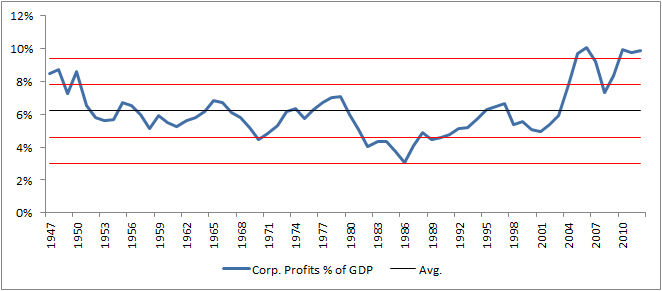
This quote caught my eye.  Using the incredibly handy FRED database excel plug-in, I decided to test this statement.  Below is a chart depicting Corporate Profits After Tax as a percentage of Nominal GDP.  Buffett was dead on with his 6% remark – since 1947 this measurement has averaged 6.1% through 2011.  In the chart below I assumed corporate profit growth of 5% for 2012 (I’m not sure what that number actually was but this is a quick and dirty analysis).  The result: corporate profits are extremely elevated compared to GDP, 2.3 standard deviations above the average if you use my 5% assumption for 2012, 2.2 standard deviations if you just look at 2011 as the latest.  Ironically it was right around 1999, when Buffett made that statement, that corporate profits as a % of GDP bottomed out and began their sustained run above 6%.

 Corp Profits % of GDP

Although I don’t have the data, I searched for “Corporate Profit Margins” and found many charts that looked like the one below.  The embedded Grantham quote is just icing on the cake, if you can read it (I didn’t actually notice it until I pasted it into this post, score).

Some have pontificated that higher profit margins are the result of broader international activity among corporations and are here to stay – Hussman, who has done is homework, has found no convincing evidence of that.  In an earlier commentary he points out that “Elevated corporate profits can be directly traced to the massive government deficit and depressed household savings that we presently observe… one will not be permanent without the other being permanent… any normalization in the sum of government and household savings is likely to be associated with a remarkably deep decline in corporate earnings

SO – what gives?  Probably corporate profit margins but WHEN that happens is anyone’s guess.

…and that is your contrarian view of the markets, thanks for joining.

P.S. Hussman’s commentary from the week before addresses the subject of corporate profit margins in much greater detail, including a version of the chart I so cleverly put together.  Unfortunately I read his posts in reverse chronological order.  For a much deeper dive on the subject read his Two Myths and a Legend post.

From Howard Marks’ latest quarterly letter The Outlook for Equities.  Looks like someone posted the full letter here.  It’s only nine pages and worth your time.

Bull Market Stages

  1. When a few forward-looking people begin to believe things will get better
  2. When most investors realize improvement is actually underway, and
  3. When everyone’s sure things will get better forever

Bear Market Stages

  1. When a few prudent investors recognize that, despite the prevailing bullishness, things won’t always be rosy
  2. When most investors recognize things are deteriorating, and
  3. When everyone’s convinced things can only get worse

As for where we’re at today (in US Equities) he thinks we’re somewhere in the first half of stage two of a bull market – pessimists no longer control market prices, but certainly neither have carefree optimists taken over.

These three paragraphs from Buffett’s 1991 shareholder letter really say it all.  He makes it sound so easy… to that he’d probably say “investing is simple, not easy”.

***

“We continually search for large businesses with understandable, enduring and mouth-watering economics that are run by able and shareholder-oriented managements. This focus doesn’t guarantee results: We both have to buy at a sensible price and get business performance from our companies that validates our assessment. But this investment approach – searching for the superstars – offers us our only chance for real success. Charlie and I are simply not smart enough, considering the large sums we work with, to get great results by adroitly buying and selling portions of far-from-great businesses. Nor do we think many others can achieve long-term investment success by flitting from flower to flower. Indeed, we believe that according the name “investors” to institutions that trade actively is like calling someone who repeatedly engages in one-night stands a romantic. 

If my universe of business possibilities was limited, say, to private companies in Omaha, I would, first, try to assess the long-term economic characteristics of each business; second, assess the quality of the people in charge of running it; and, third, try to buy into a few of the best operations at a sensible price. I certainly would not wish to own an equal part of every business in town. Why, then, should Berkshire take a different tack when dealing with the larger universe of public companies? And since finding great businesses and outstanding managers is so difficult, why should we discard proven products? (I was tempted to say “the real thing.”) Our motto is: “If at first you do succeed, quit trying.”

John Maynard Keynes, whose brilliance as a practicing investor matched his brilliance in thought, wrote a letter to a business associate, F. C. Scott, on August 15, 1934 that says it all: “As time goes on, I get more and more convinced that the right method in investment is to put fairly large sums into enterprises which one thinks one knows something about and in the management of which one thoroughly believes.  It is a mistake to think that one limits one’s risk by spreading too much between enterprises about which one knows little and has no reason for special confidence. . . . One’s knowledge and experience are definitely limited and there are seldom more than two or three enterprises at any given time in which I personally feel myself entitled to put full confidence.”

***

Found via: Value Investing World

Anyone who follows this blog knows I’m a HUGE fan of Jeremy Grantham.  He is an incredibly smart man and has the added benefit of being English, so even if you find the substance of his discussions to be boring you can at least enjoy his accent.  You should read his quarterly letters over at GMO.com, I’d put them right up there with Buffett’s Berkshire letters.

Anyone who supports the Keystone Pipeline needs to watch this.

http://www.charlierose.com/view/content/12812

A few days ago I stumbled upon a real gem – it was the key note speech to the Financial Analysts Federation Seminar at Rockford College on August 9, 1981 delivered by Dean Williams who was a Senior Vice President at Batterymarch Financial Management.  The speech is called “Trying Too Hard” (link).

Dean lays out the idea that those in the investment management business are routinely trying too hard – there seems to be a vested interest in creating complexity as opposed to simplicity.  He compares finance to physics in that if you learned enough about the laws that govern the physical (or financial) world you could extend your knowledge or influence over your environment.  If you just worked hard enough – learned every detail about a company, discovered just the right variables for your forecasting models then earnings, prices, and interest rates would all behave in rational and predictable ways.  Unfortunately, in the financial world (and sometimes in the physical world) things don’t play out in rational or predictable ways, no matter how much understanding you develop.

Humans are just not good at predicting things – what earnings will be in a few years, when interest rates will peak, what inflation will be.  Most people in finance spend much of their time accumulating information to help make forecasts of all the things we have to predict.  Dean concludes that confidence in a forecast rises with the amount of information that goes into it but the accuracy stays the same.

So does this mean all professional investors are categorically useless?  No!  The good news is you can be a successful investor without being a perpetual forecaster.  Dean mentions one of the most liberating experiences you can have is to be asked to go over your firm’s economic outlook and say “We don’t have one”.

If there is a reliable and helpful principle at work in our markets its mean reversion – the tendency toward average profitability is a fundamental, if not the fundamental principle of competitive markets.  It’s an inevitable force, pushing profits and valuations back to the average.  This makes for a powerful investment tool.  It can almost by itself select cheap portfolios and avoid expensive ones.  The plain English equivalent Dean offers is “that something usually happens to keep both good news and bad news from going on forever”.

So besides having a healthy respect for mean reversion what other qualities can one bring to the table?  He offers a few:

  • Simple Approaches – he quotes Einstein as saying “most of the fundamental ideas of science are essentially simple and may, as a rule, be expressed in language comprehensive to everyone” and remarks that his own reaction was “sure, that’s easy for him to say” but as long as there are people out there who can beat professional investment managers using dart boards, he urges us all to respect the virtues of a simple investment plan
  • Consistent Approaches – establish your approach and stick with it.  He lists some of the top performing funds (circa 1981) and highlights the main thing they all had in common was the discipline to stick to their approach, to stay consistent
  • Tolerance for the concept of “Nonsense” – or what the Zen call “Beginner’s Mind”.  Expertise is great, but it has a bad side effect – it tends to create an inability to accept new ideas
  • Spend your time measuring value instead of generating information – As mentioned before, most of us in finance spend our time gathering information and using it to make predictions.  Dean advises us don’t forecast – buy whats cheap today; let other people deal with the odds against predicting the future

He goes on to mention an interesting study about man’s ability to forecast.  A Wharton professor named J. Scott Armstrong published an article called “The Seer-Sucker Theory” where he collected studies of experts’ forecasts in finance, economics, psychology, medicine, sports and sociology.  The summary of his findings is that expertise, beyond a minimal level is of little value in forecasting change.  The punchline of his findings was “no matter how much evidence exists that seers do not exist, suckers will pay for the existence of seers”

***

That’s a very rough outline of the speech – it looks longer than it is and it’s quite an enjoyable read; if you liked what you read here then go read the whole thing (link).